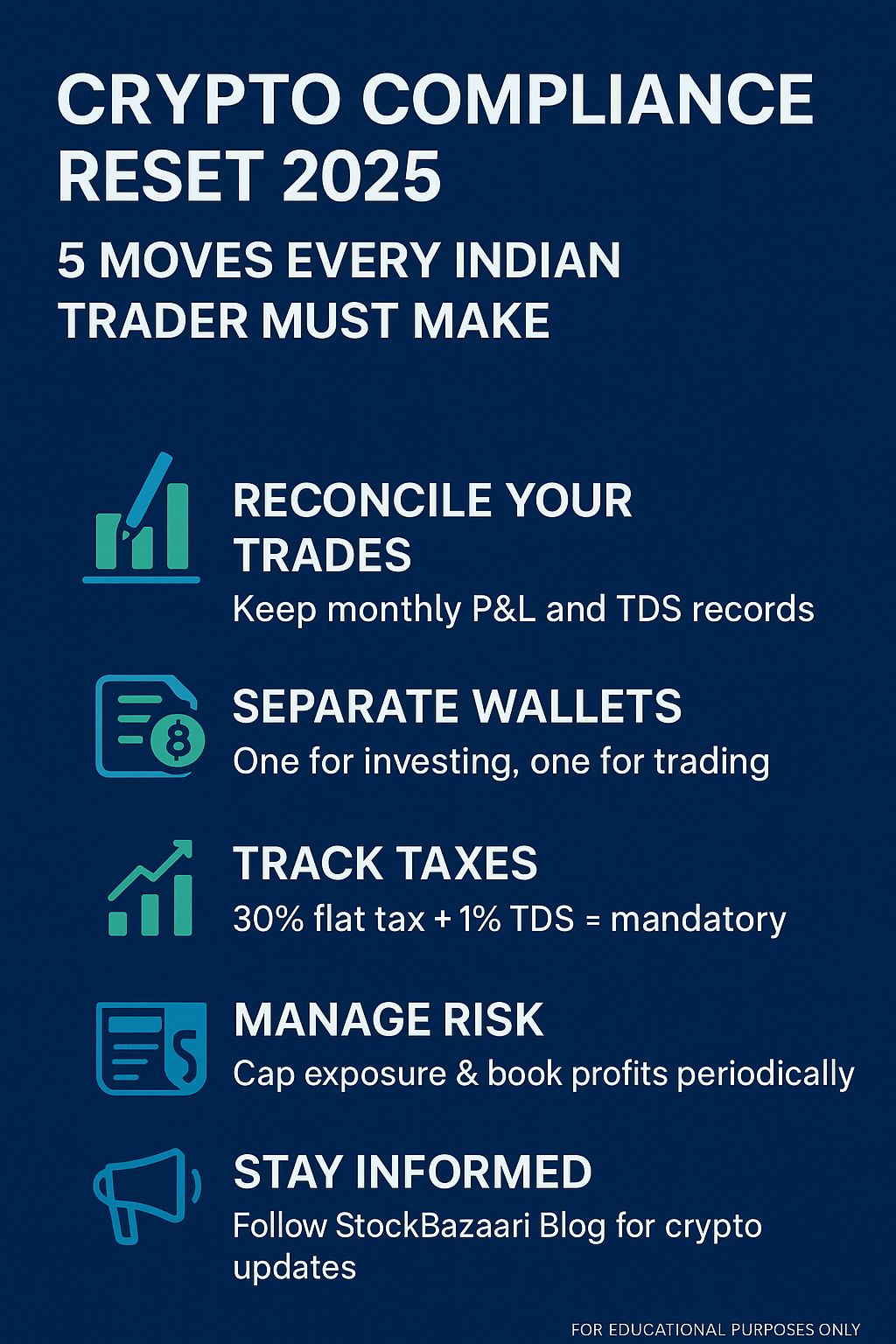
Intro: The New Reality for Indian Crypto Traders
Crypto trading in India has entered a new phase. After the 2025 tightening of compliance rules and reporting norms, traders can no longer treat crypto like an off-the-books side hustle. Whether you hold, trade, or cash out — every move now leaves a paper trail and a tax implication.
So what does this mean for you? It’s time to rethink your approach — from record-keeping to risk management — and move from fear to clarity.
1️⃣ Quick Recap — What Changed in 2025
India’s crypto tax structure still stands on three pillars:
-
Flat 30% tax on profits from virtual digital assets (VDAs).
-
1% TDS deducted on every trade above ₹50,000 per year (on registered platforms).
-
No loss set-off between crypto and other income classes (equities, mutual funds, etc.).
What’s new in 2025:
-
Exchange compliance tightened — KYC verification mandatory even for P2P trades.
-
Tax audit triggers broadened — if your crypto volume exceeds ₹10 lakh, expect reporting scrutiny.
-
Foreign wallet tracking initiatives — Indian tax authorities now exchange data via global agreements.
2️⃣ Information vs Knowledge — Know Your Edge
Information is knowing that crypto is taxed at 30%.
Knowledge is understanding how to structure your trades so you don’t bleed extra TDS or lose offset opportunities.
3️⃣ What Investors Should Do Today
If you buy and hold crypto for long term (>12 months):
-
Maintain a record of each purchase and sale (in INR value on the day of transaction).
-
Consider holding through registered Indian platforms to ensure TDS credit is visible in Form 26AS.
-
Avoid mixing personal wallets and exchange wallets — audit trails get confusing.
-
Keep a small portion in cold wallet for security, but record transfer dates and values.
4️⃣ What Active Traders Should Do Now
If you are doing F&O or high-frequency crypto trading (even on foreign exchanges):
-
Treat it like a business — maintain trade ledgers, P&L statements, and expense records (server costs, internet, API fees).
-
Don’t mix investment trades with derivatives; the tax treatment is different.
-
Keep a monthly reconciliation sheet for trades and TDS deductions.
-
If you use international platforms, track converted INR values daily — the Income Tax Dept considers INR valuation for each event.
5️⃣ Crypto Losses & Tax Reality
Let’s simplify the common confusion through an example:
You lost ₹2 lakh in crypto investments (spot coins) but earned ₹3 lakh profit in crypto trading (F&O).
Here’s how tax works:
-
Investment loss (spot) cannot be set off against trading profit (F&O).
-
You will be taxed on the entire ₹3 lakh profit.
-
The ₹2 lakh loss cannot be carried forward or adjusted — this is explicit in VDA rules.
✅ Pro tip: Keep your spot and trading ledgers separate. That small discipline can save you from notices and interest penalties.
6️⃣ Risk Management in 2025 Markets
Crypto volatility is not gone — it’s just evolving.
Adopt these three rules like a professional trader:
-
Cap your exposure: Never risk more than 5-10% of your capital in unregulated tokens.
-
Use hedges: Offset big positions with short-term hedges or stablecoin buffers.
-
Book profits periodically: Crypto gains are taxed per event — not at withdrawal. Booking quarterly helps you manage cash flow and tax liabilities.
7️⃣ Documentation Checklist (Quick Snapshot)
Before you file your 2025-26 return, make sure you have:
-
📄 Exchange trade statements for each platform.
-
💰 TDS summary (Form 26AS + broker ledger).
-
💹 Bank and wallet transfer proofs.
-
🧾 P&L summary (spot + F&O separate).
-
🪙 INR valuation of crypto holdings on March 31, 2025.
8️⃣ Action Plan — The StockBazaari Checklist
| Step | Action | Why It Matters |
|---|---|---|
| 1 | Reconcile all trades monthly | Avoid mismatched income records |
| 2 | Keep investment and trading wallets separate | Helps clarify tax type |
| 3 | Track TDS and GST if applicable | Required for high-volume traders |
| 4 | Use research-driven decisions | Avoid losses from random bets |
| 5 | Stay updated with compliance alerts via StockBazaari Blog | Regulation changes fast — stay ready |
Closing Thoughts
Crypto is here to stay — but the easy, anonymous days are over.
The new era rewards informed, disciplined, research-backed traders who play by the rules.
Start your “Crypto Reset” by tidying your records, managing risk, and making informed trades with a clear tax plan.
That’s how you trade smart — not just hard.